
Spring in the Hills: Alberta Field Crew 2026 Updates

After overwintering in the office, the Freshwater Conservation Canada (FCC) Alberta field crew was itching to get back to the field as soon as possible. With this year’s field season now in full swing, it’s about time for an update on what we’ve been up to! Since the weather has allowed, we have been getting out to the Porcupine Hills, in southern Alberta’s Eastern Slopes. Our field work trips often feature an FCC field day staple – a quick A&W fuel stop, although the team is trying to diversify their breakfast spots this year.
FCC has ongoing projects throughout the Porcupine Hills which includes monitoring, fish sampling and reclamation work. One of our large ongoing projects takes place in the Callum Creek watershed, a tributary to the Oldman River. This watershed supports genetically pure populations of Threatened Westslope Cutthroat Trout. Our projects in the area are focused on improving habitat conditions for this species and on gaining further understanding about the watershed and the species themselves.

In 2025, 41 Beaver Dam Analog (BDA) structures were built along the north fork of Sharples Creek (unofficially named Prong Coulee), a tributary to Callum Creek. In April 2026, the crew went out to do some early season recon for future BDA sites and a bit of maintenance. During this visit, some of our structures were ponding water, others were dry, and a few were still covered in a thick sheet of ice. As is often the case, our crew members were keeping their eyes peeled in hopes to see one of the Westslope Cutthroat Trout that inhabit this stream. Luckily, this time around, some members of the crew did spot a small trout swimming in one of the BDA ponds. It is always rewarding to see one of the species we are working to protect!

A couple of weeks later, we had the pleasure of having a class from Lethbridge Polytechnic come out to Sharples Creek to help us with BDA construction and maintenance. On a snowy mid-April day, we had 30 eager students helping us gather material, pile dirt and sticks, and pound posts. With such a great crew we had already built a handful of new BDAs before lunch time.
Another aspect to our work on Sharples Creek is monitoring fish movement. Last year, FCC installed four fish arrays to detect the movement of Westslope Cutthroat Trout through Sharples and Playle Creek, tributaries of Callum Creek. This was paired with a large sampling event organized with our partners from the AEPA and FRI Research. Both creeks were sampled extensively and all Westslope Cutthroat Trout that met our size criteria were “tagged” with a small passive integrated transponder (PIT) tag. Arrays were constructed at key points on the creeks and as “tagged” fish swim by, they are detected and logged by the arrays. The arrays were offline over the winter and needed to be booted back up to detect fish movement during the warmer months of the year. This spring, it was time to replace the large batteries that provide power to the arrays. Unfortunately for us, this required hiking out the old batteries last fall and hiking in the new (thankfully lighter) batteries this spring. The crew will be visiting our arrays regularly to ensure they are working properly and hopefully they will start pinging some fish as they swim by.

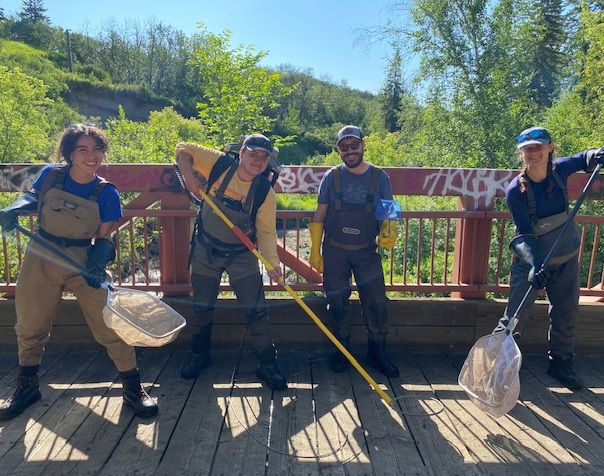
Beaver Creek is another tributary of the Oldman River that flows through the southern extent of the Porcupine Hills. Beaver Creek is also home to Westslope Cutthroat Trout and is the site of another ongoing project. A crew went out to electrofish four reaches of Beaver Creek that had not been sampled in just over a decade. The goal of this effort was to gain updated information on the presence of Westslope Cutthroat Trout in the upper reaches of the creek. The crew unfortunately caught no Westslope Cutthroat Trout during this effort, but did catch some Longnose Dace, Fathead Minnow and a variety of suckers, all native species to Alberta. Additionally, the crew ran into a local dog that was looking for a few pets and the crew was happy to oblige. Although the trip did not accomplish what it had set out to do, the crew was happy to be out fish sampling rather than being cooped up in the office for the week.

Since our Alberta office is based out of Calgary, our trips involve a lot of driving, which leads to a lot of time spent chatting with your coworkers, listening to silly music and our new favourite: playing daily musical trivia games. It’s safe to say that the FCC field crew trucks are a pretty great place to be. We still have quite a bit more work to do out at our Porcupine Hills sites, and the crew is excited for what’s to come.

Our work in the Porcupine Hills is made possible by our funders from the Alberta Ecotrust Foundation Grant, the Canada Water Agency Ecoaction Grant, and the Alberta Conservation Association Community Grant.


Comments