
I'm New to This!!!

Updated: Jul 24
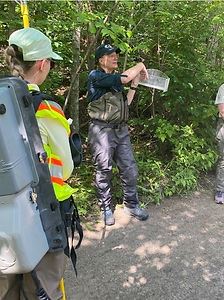
When my team encouraged me to join the conservation crew for a two-day sampling trip in Edmonton, I jumped at the opportunity to get moving and take a break from sitting at my desk.
Now, let it be said that I've had no experience in conservation work before this trip. As the new Marketing & Communications Coordinator at Freshwater Conservation Canada, my biggest work concern to date has been testing how many office ice cream sandwiches I can consume per day before my boss notices the rapid pace at which they're disappearing. Spoiler alert: it's two.
The day started at the crack of dawn. The conservation crew picked me up at the nearest Starbucks location close to my house at 7:45 am. From there, the crew drove from Calgary to Edmonton to meet up with its partners for this collaborative project, including EPCOR, VIDEA, the North Saskatchewan Watershed Alliance, the Opitemisiwak Métis Government, and the University of Alberta.

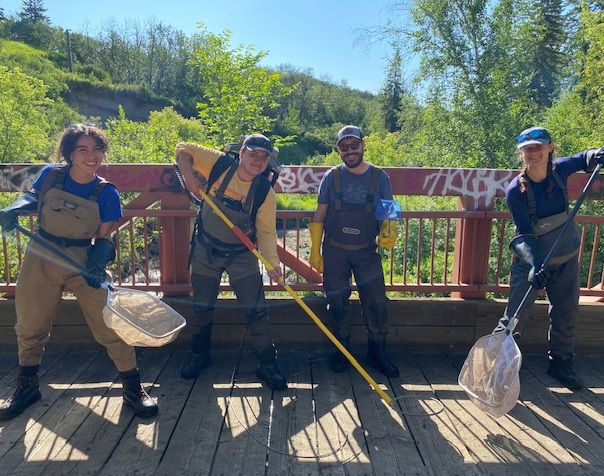
Upon arrival, it was determined early on that the downstream sites were too hazardous to sample. Nevertheless, we still resumed our plans for the other creeks, where I had my first experience wearing electrofishing gear. They're these big, oversized overalls that overheat your body like a second skin and help you navigate through the water, as it provides some form of protection when you're sampling for fish. They were definitely a lot more comfortable than they looked.
After a brief safety speech from Lesley and the rest of the team, we all split off into three teams. I followed Lesley's team to Fulton Creek.
The plan was simple. Sample the water, analyze its state, and hope the other members that accompanied us would gain some electrofishing knowledge by the end of the day.
Only, there were no fish. Some of the bodies of water we looked into had plenty of deadfall, but no fish. I think Tinder had more fish in the sea than what we saw.
With very little to work with, Lesley's team and I headed to Deanna and Casper's team at upstream Mill Creek in the late afternoon, where they had caught over 100 sticklebacks. I was excited at the prospect of seeing what happens after the fish are caught and sampled.
My expectations did not prepare me for the reality that awaited me. The heat had already tanned my skin like a rotisserie chicken, but I was not expecting the onslaught of mosquitoes. They were everywhere. In your back, in your clothes, in your ears. It was an all-you-can-eat mosquito buffet. You couldn't talk without risking a mosquito getting in your mouth. I think I swallowed two mouthfuls of je ne sais quoi. If it sounds gross it is because it was.

And the mud. The deep, deep mud. It stuck to your feet like glue. The closer I treaded to the creek, the deeper the mud stuck around my boots. At some point, I could not extract my feet. I tugged. Nothing budged. Not even a disturbing alteration of the Cupid Shuffle got me out as the mud alarmingly started to reach my calf.
It was only with the help of Lesley that I got out of that sticky mess. After that, I strayed from the bank of Mill Creek.
Not everything was bad, though. Quite the opposite, actually. The team managed to sample over 300 sticklebacks, and the other creeks that were examined turned out to be healthy.
The highlight of the day, however, came towards the end when we all took off our waders. Turns out marinating in my own sweat while wearing oversized overalls does wonders for hydrating my skin. If you want an au naturel skin care routine, this would be it. Never let it be said I gatekeep beauty secrets.
In my experience, the best part of the trip came on the second day, which was a shame because I had to leave midday to make the drive back to Calgary (three hours if you follow the speed limit—which I did, obviously).
The morning started out with me making dumb decisions. I opted out of wearing waders. Why, you ask? I couldn't tell you. Let me caution you though: never not wear waders. My sneakers became one with the mud, and the shorts did not help.
Goldbar Creek was on the schedule that day. It proved to be the star of the show. Goldbar Creek hosted a variety of diverse fish to sample, enhancing the experience of everyone who attended. Even more, it was home to a number of Prussian Carp, an invasive fish. While that doesn't bode well for native species, it did paint me a picture of what species belong in Alberta aquatic streams and which ones don't. The rest of the team was excited at the variety of fish they found, and that excitement transcended well when it was time to record the sizes and populations of the fish.
I think what floored me the most was finding the weird conditions some of the fish were found in. You might think, duh, of course fish get sick and injured. Listen, I know next to nothing when it comes to aquatic species. I didn't even finish watching Finding Nemo as a child. It was all a blank slate for me.
About several fishes had giant cysts protruding from the sides of their body. Another had a weird arch on its back. I think I even saw one with one of its fins cut off. I watched and recorded everything with the same fascinated disgust as one would watch Dr. Pimple Popper on YouTube. In the midst of all the novelty that occurred in a short span of time, the hours flew by.
Now, I don't think I've done the best job at portraying the trip in the most positive light thus far. That's because this narrative wouldn't be authentic if I portrayed it as all flowers and roses.
What I can say is that while I sat in the riparian zone of the creek while the team and I were struggling to determine the classification of a certain fish, I had a sudden strike of clarity. You know, the ones you get when time pauses a little, and you're hit with an epiphany that makes you go, oooo yes. I get it. I get it now.
I understand why people delved into this kind of work. All mosquito bites, mud clinging, and transpiration overload aside, there was a certain sense of fulfillment you feel at the end of the day when looking back at the work you did. It's rewarding, I think, to feel like your work means something. In today's age of environmental degradation, you hope that behind every invasive species you catch, every tree you plant, and every creek you observe, it might count for something to restore what had been damaged. I know I definitely felt good about the work we did.
And most of all, I left feeling a newfound respect for the conservation crew that consistently pulls these long days to make this work happen. It wouldn't be possible without them.

Comments