
THE UPDATE NO ONE ASKED FOR: Fall Creek Field Trip September 16-17, 2026

Breaking news, guys: the office is out of ice cream sandwiches. Alexa, can you play “Me and My Broken Heart,” please? Whether that decision was the result of my gluttonous ice cream indulgence or a mere coincidence, I couldn’t tell you.
Another update: the team asked me to go on another trip. This time, to see our organization's amazing work in collaboration with the Government of Alberta, fRI Research, University of Calgary, Alberta Conservation Association, and West Fraser at Fall Creek. The plan was to move threatened Bull Trout from lower Fall Creek, a key spawning habitat for Bull Trout, upstream of a natural waterfall to expand the range of Bull Trout in Alberta. This is known as conservation translocation. Alongside some habitat restoration done earlier this year, this work will bolster the resiliency of Bull Trout populations in the watershed.
Were you impressed by that explanation, hmm? The team helped me write that.

But anyways.
It was all a one-week trip for most of the crew. Lesley, Kate, and I planned on meeting the rest of the team in Rocky Mountain House on Wednesday, September 16th. Lesley and Kate were going to stay there until the next day. I was potentially staying until Friday evening. All we were waiting for was the green light from the conservation crew already at Fall Creek to confirm that fish were spawning around the area.
Only, the green light took a while to come.
Yep, that's right, y'all. Romance was dead among Bull Trout. Maybe the economy in Fall Creek was just as rough for them as it was for us.
We ended up driving to Rocky Mountain House in the late afternoon. Bought some snacks and ate one or two (or half a dozen) fudge Reese's peanut butter cups. It was already late when we got into our cabin, so it didn't take long for us to unwind in our cabin rooms to get ready for the next day.
Except that's not quite how it happened.
Now, I was under orders to write this trip optimistically, so bear with me on this next part.
The fire alarm popped off during the night. Multiple times. Multiple.
Was it my favourite lullaby to doze off to? Perhaps not. Did it make me question my sanity a little bit? Just a smidge.
We woke up at around 7 AM to get ready. Despite the lack of sleep from the pleasant and tranquil fire alarm, I genuinely felt full of energy. The brief trip to the local A&W before meeting all our partners helped with the energy boost throughout the day.

We met our partners in a remote location to hash out the plan for the day. Our group planned to work with the Government of Alberta that Thursday and hike a 9 km trail to make our way to Lower Fall Creek and watch the team collect eggs and milt from ripe Bull Trout – those that were ready to spawn.
Only, there was one catch.
The trail was decommissioned and intentionally designed to prevent vehicle access. Most people would turn back and give up on finding the fish around this area. And said people – like moi – were meant to use this trail.
I didn't know any of that, or maybe those warnings were lost under the excitement of all the other things that were happening. I suddenly understood why my bosses warned me to bring walking sticks. It was always something I considered beneath me. Walking sticks? With my prime age and youth bod? Nuh-uh.
I quickly ate those thoughts up within half an hour of hiking.
You've ever seen a baby gazelle learn how to walk for the very first time? This was me hiking along the forest trail. Thankfully, the crew was really supportive in making sure everyone was safe. Those hiking poles saved me more times than I could count.
We went over trees, crawled under them, sidestepped them. Downhill trails that were so steep, I fell on my . . . you know what? You get the picture.
By the time we had to crisscross the creek in our waders, I thought that the worst of it was over. I was wrong. It proved to be more difficult. However, the view got more beautiful as the sunlight hit the varying shades of green in our path. Even better, it gave us a clear view of the activities happening under the creek.
The best part of that hike was having to do the shimmy shimmy along a ridge of rocks within the creek. Despite it being the most hazardous part of the trip, I thoroughly enjoyed testing how far I could stretch in a pair of waders. They test your flexibility, I tell you.

At long last we reached the spawning site, where the Government of Alberta team already had set up spawning tents on the stream bank. Behind this setup, a beautiful waterfall beheld us in the background near the site, making a series of white noise.
As I neared the site, the team was already busy catching, assessing, clipping, and tagging Bull Trout held in totes.
This trip was my first time seeing Bull Trout in the flesh. I didn't have many expectations going into it, but I definitely didn't anticipate how big they were. The pictures didn't do them justice. Some of them were about as long as my arm.
I watched the Government of Alberta team closely as they caught Bull Trout and checked if they were ripe and ready to spawn. Apparently, Bull Trout only start growing their eggs as they approach the fall spawning season. Catch them too early, and their eggs aren’t fully developed yet. Catch them too late, and they will already have released all their eggs for the year. For this conservation translocation project, the right timing was crucial.
While one Bull Trout female had spawned before we arrived, the other females didn't show signs of readiness.
Maybe more than an hour later, I had the privilege of witnessing the first ripe female Bull Trout; this gal was ready to go!
I watched in awe as a Government of Alberta team member gently squeezed the underside of her belly in a practiced move, and she popped off thousands of eggs into a strainer. While the sight was cool, I found out the hard way that parfum de poisson did not settle well into my nostrils. I had to cover my nose to capture a video of the cool female Bull Trout spawning

During those few hours, I learned more in this project about fish species than I did reading behind a computer screen. It's a lot easier to filter through differences in fish in person than on paper.
In the end, eggs were collected from 3 female Bull Trout and milt from 9 male Bull Trout and released back into the water. Apparently, the next day, crews fertilized the eggs, and then half of them placed them in RSIs (remote site incubators), and half were transported to the Allison Creek Brood Trout Station where they will be hatched; these babies will be stocked into upper Fall Creek next spring. RSIs are essentially man-made fish nests, which protect the growing eggs from being eaten or trampled. These RSIs were then buried in the streambed, the same way Bull Trout bury their eggs within their redds, to incubate and hatch.
Our conservation team, along with other partners, handled that part. The eggs will stay buried over the winter and hatch in the new year. This is all part of a four-year project where the goal is to create a self-sustaining population of Bull Trout in Upper Fall Creek.

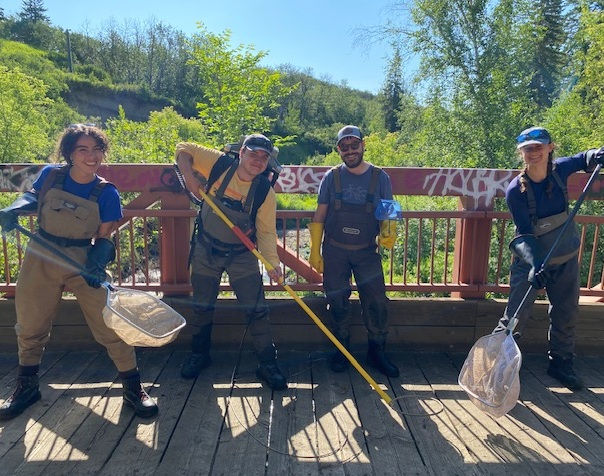
Before wrapping up, we all agreed to take pictures of the crew with the waterfall in the background. As my boss snapped a picture, a glorious Bald eagle flew off into the distance, putting me in a state of shock.
Did y'all know there are Bald Eagles in Alberta? Alberta? Colour me excited by this piece of information I learned.
Kate, Lesley, and I received at least a half-hour head start making it across the other side of the hiking trail before the Government of Alberta crew packed up. Nevertheless, they caught up to us anyway.
I thought the way back would feel smoother. It was not. Have you ever had to hike uphill on the way back? It was as gruelling as the first time around.
My stomach was growling with an appetite equivalent to a bear fresh out of hibernation. I craved a cold beer. I've never craved beer in my life. I was sweating through my clothes, armpits, everywhere.
Either way, our team powered through the hike back. Kate and Lesley were set to return the same day. I was scheduled to potentially stay another night.
As I was taking off my waders in our parking lot, Jess from the Government of Alberta asked me, "So are you staying here tomorrow?"
Listen, I could've stayed another day. I could've. Really. I don't think my face expressed that, though, because Lesley saw one look at my face and said, "She'll be coming back with us.”
And so I did.

In addition to the partners listed above, Freshwater Conservation Canada is grateful to Environment and Climate Change Canada, Fisheries and Oceans Canada, and the Forest Resource Improvement Association of Alberta for their financial support for this project.
Comments